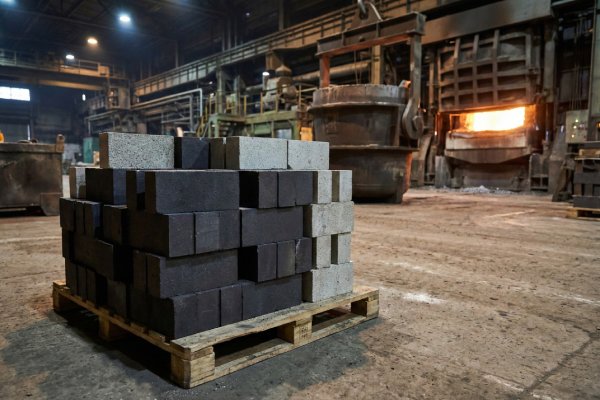
ASTM C455 certified basic refractory bricks with 85-98% MgO content engineered for superior resistance to basic slags in steelmaking, cement production, and non-ferrous metallurgy applications operating at temperatures up to 1850°C.
Basic refractory bricks are alkaline oxide-based materials characterized by high magnesia (MgO) and/or calcia (CaO) content, engineered to resist corrosive attack from basic slags containing high concentrations of CaO, MgO, and FeO encountered in steelmaking and cement production. The term "basic" refers to their chemical basicity (pH >7), contrasting with acidic refractories rich in silica and alumina.
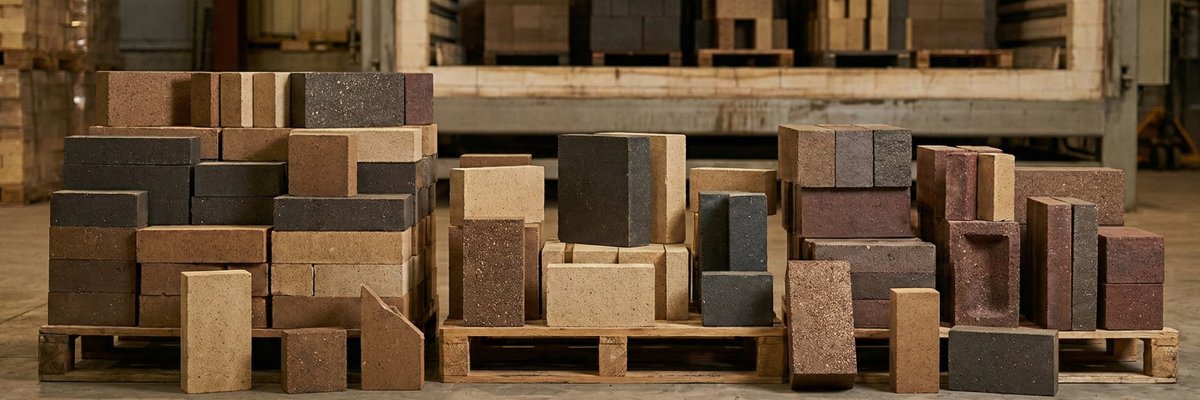
Our basic refractory portfolio includes magnesia bricks (85-98% MgO), magnesia-chrome bricks (MgO-Cr₂O₃ combinations), dolomite bricks (MgO-CaO), and magnesia-alumina spinel bricks (MgO-Al₂O₃). Each composition is optimized for specific slag chemistries, thermal cycling conditions, and mechanical loads. Manufacturing employs high-purity raw materials including fused magnesia, electro-fused magnesia, and seawater magnesia, processed through isostatic pressing or direct-bonding techniques to achieve superior density and direct periclase-periclase bonding.
Compliance with international standards including ASTM C455 (magnesia bricks), ASTM C456 (magnesia-chrome bricks), ISO 10081, and JIS R2213 ensures consistent quality. Every batch undergoes rigorous testing for MgO and Cr₂O₃ content, bulk density, apparent porosity, cold crushing strength, and refractoriness under load. Our manufacturing partners employ advanced bonding technologies including direct-bonded (DB), rebonded-fused grain, and co-clinker processes. Complete mill test certificates and technical documentation accompany all shipments.
Exceptional resistance to CaO-MgO-FeO slags in BOF/EAF steelmaking
Operating capability up to 1850°C with RUL values 1600-1700°C
Mag-chrome grades withstand BOF/EAF thermal cycling and thermal shock
Superior periclase-periclase bonds for enhanced strength and corrosion resistance
Comprehensive range of basic refractories optimized for different slag chemistries and operating conditions
Pure magnesia bricks with 85-98% MgO content. Excellent basic slag resistance for steelmaking and cement production. Available in rebonded and direct-bonded grades.
MgO-Cr₂O₃ composite offering superior thermal shock resistance and corrosion resistance. Optimal for BOF converters experiencing severe thermal cycling.
Cr₂O₃-dominant composition with lower MgO content. Enhanced resistance to ferrous oxide penetration. Specialized for copper smelting and specific steel applications.
MgO-CaO based refractories from dolomite (CaMg(CO₃)₂). Excellent for basic slag zones but requires careful storage due to CaO hydration susceptibility.
MgO with MgAl₂O₄ spinel phase providing excellent thermal shock resistance and slag corrosion resistance. Increasingly popular for steel ladles and tundishes.
Advanced technology with direct periclase-periclase bonding through high-temperature sintering. Superior strength and slag resistance for critical applications.
Comprehensive specifications for basic refractory bricks
| Property | Unit | Magnesia | Mag-Chrome | Chrome-Mag | Dolomite | DBM |
|---|---|---|---|---|---|---|
| MgO Content | % | 85-98 | 60-80 | 30-50 | 35-45 | 95-98 |
| Cr₂O₃ Content | % | ≤1.0 | 8-30 | 30-50 | ≤0.5 | ≤1.0 |
| CaO Content | % | ≤2.5 | ≤2.0 | ≤5.0 | 40-55 | ≤1.5 |
| Refractoriness Under Load | °C | 1550-1650 | 1600-1700 | 1580-1650 | 1500-1600 | 1650-1700 |
| Maximum Service Temp | °C | 1650-1800 | 1700-1850 | 1650-1800 | 1600-1750 | 1750-1850 |
| Bulk Density | g/cm³ | 2.9-3.1 | 3.0-3.3 | 3.1-3.4 | 2.8-3.0 | 3.0-3.2 |
| Apparent Porosity | % | 16-20 | 14-18 | 15-19 | 18-22 | 12-16 |
| Cold Crushing Strength | MPa | 40-60 | 50-70 | 50-70 | 35-50 | 60-80 |
| Thermal Expansion (1000°C) | % | 1.3-1.5 | 1.2-1.4 | 1.1-1.3 | 1.4-1.6 | 1.3-1.5 |
Basic refractories serve critical applications in steel, cement, and non-ferrous metallurgy
BOF/EAF converters, steel ladles, tundishes, torpedo ladles, AOD/VOD converters, RH degassers, EAF sidewalls and bottoms.
Learn MoreCement rotary kiln burning zones, transition zones, lime kilns, coating layers, high-alkalinity environments.
Learn MoreCopper converters, lead blast furnaces, nickel smelters, flash smelting furnaces, reverberatory furnaces.
Learn MorePhosphorus furnaces, calcium carbide furnaces, high-temperature chemical reactors operating in basic environments.
Learn MoreEngineered for CaO-MgO-FeO slags with C/S ratios >2.0 common in BOF/EAF steelmaking. MgO-based chemistry resists corrosive dissolution by basic slags through thermodynamic compatibility. Direct-bonded periclase grains minimize secondary phases susceptible to slag penetration. Achieves 2-3x longer service life than acidic refractories in basic environments.
Magnesia-chrome combinations provide exceptional thermal shock resistance critical for BOF/EAF thermal cycling (scrap charging, tapping cycles). Cr₂O₃ addition creates microcracks that accommodate thermal stress, reducing catastrophic failure. Withstands temperature swings of 500-800°C during tapping and charging operations. Mag-spinel grades offer balanced thermal shock and slag resistance.
Advanced direct-bonded manufacturing creates strong periclase-periclase bonds through high-temperature sintering at 1700-1800°C, eliminating weak silicate bonding phases. Superior mechanical strength (60-80 MPa vs 40-60 MPa for rebonded), better RUL (1650-1700°C vs 1550-1650°C), enhanced slag corrosion resistance. Optimal for critical zones: BOF slag lines, EAF hot spots.
Operating capability up to 1850°C for magnesia-chrome grades. High melting point of MgO (2800°C) ensures stability at steelmaking temperatures. Refractoriness under load values 1600-1700°C maintain dimensional stability under combined thermal and mechanical loads. Minimal creep at operating temperatures preserves lining geometry and prevents premature failure.
Full compliance with ASTM C455 (magnesia bricks), ASTM C456 (magnesia-chrome bricks), ISO 10081, and JIS R2213 standards. ISO 9001:2015 certified manufacturing. Comprehensive testing per ASTM C20 (porosity/density), ASTM C133 (crushing strength), ASTM C16 (RUL), ASTM C1171 (chemical analysis). Mill test certificates, TDS, MSDS provided. SGS/Bureau Veritas inspection available.
Serving steel and cement industries in 30+ countries. Expert packaging with moisture-barrier wrapping protecting against hydration during shipping. Wooden pallets, steel strapping, container stuffing expertise. Complete export documentation. FOB, CFR, CIF terms. 4-6 week lead times. Technical support for lining design, installation practices, heat-up schedules. Application engineering assistance.
Common questions about basic refractory bricks
Complementary refractory solutions for steel and cement applications
Specialized refractories for ladles, tundishes, slide gates, and continuous casting applications.
Learn MoreMagnesia-based monolithic refractories for gunning, patching, and complex geometry applications.
Learn MoreMagnesia-based mortars for laying basic refractory bricks in steel and cement applications.
Learn MoreComplementary acidic/neutral refractories for areas not exposed to basic slags.
Learn MoreGet expert consultation on magnesia, magnesia-chrome, and dolomite brick selection. Our refractory engineers analyze your slag chemistry, thermal cycling, and operating conditions to recommend optimal solutions for maximum campaign life.